The Customer at the Centre
At the Intercharge Network Conference in Berlin, Eldrive Romania's Technical Director Dragoș Teodorescu set out how measured data — traffic, dwell time, utilisation curves and grid capacity — decides what gets built, where, and how far ahead.
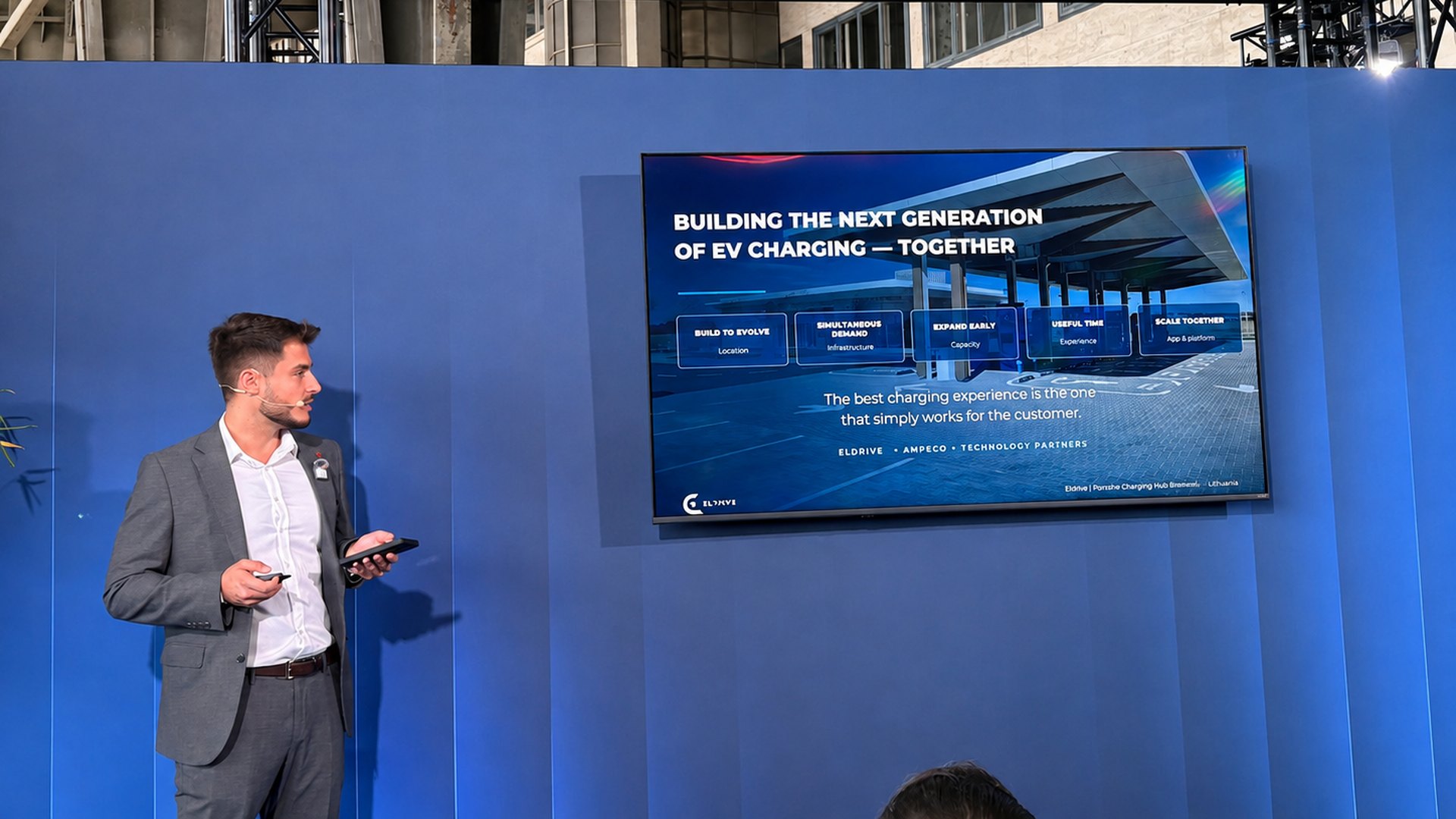
Interview with Dragoș Teodorescu
Recorded at icnc26 in Berlin: how a site goes from concept to a working high-power hub, what drivers need from a charging stop, what working with several hardware vendors has taught the team, and where the network goes next.
What was presented
Every Eldrive location is designed as an upgrade path, not as a finished object — grid capacity, civil works and space are reserved from day one.
With the network and charging sessions both roughly doubling year on year, capacity has to be planned 24 to 36 months before the demand it serves.
Shared, dynamically allocated power pools — 1 MW at Pitești, 720 kW at XO Park Sofia — beat fixed per-bay output when the arrival mix is unpredictable.
The average stop at Eldrive's Raseiniai highway hub in Lithuania is 25 minutes. That single number decides how many bays a site needs, and what has to be built around them.
One account, one app and one platform across Bulgaria, Romania and Lithuania — with multi-vendor integration kept in-house.
The figures behind the talk
Eldrive is part of the Renalfa energy ecosystem and operates public charging in Bulgaria, Romania and Lithuania. These are the figures Dragoș Teodorescu put on screen in Berlin.
icnc26 is where the people who build and run charging networks meet once a year, and this year it filled the hangars at Berlin Tempelhof. Eldrive's contribution to it was deliberately unglamorous. Dragoș Teodorescu's argument was that almost everything a customer actually notices about charging — whether a bay is free, how long the stop takes, whether the session starts on the first attempt — was decided two or three years earlier by an engineer looking at traffic counts, grid capacity and utilisation curves.
The planning problem: everything is doubling
Across the Eldrive group, both the network and the number of charging sessions have been roughly doubling every year: on the group's own index, 2026 is forecast to reach about eight times the 2023 level. A network growing at that rate cannot be planned reactively. Grid connections, civil works and equipment lead times mean capacity has to be committed 24 to 36 months before the demand it is meant to serve actually arrives.
Turning market signals into infrastructure decisions
Teodorescu set out the four-stage method Eldrive applies in all three markets.
- What we observed. Traffic on strategic routes, EV registrations by city and region, Eldrive's own sessions and utilisation by hour, day and season, measured dwell time, and what the grid connection at each site can actually deliver.
- What we decided. The role of the site — highway, urban, retail or fleet — determines the answer, because each has a different peak shape. From that follow day-one capacity, the number and power of bays, and how much grid, space and technical capacity is reserved for the next step.
- What we built. Right-sized multi-bay locations for each demand profile, with the reserve made physical: cable, transformer capacity, civil works and space, so that adding chargers later is an addition rather than a rebuild.
- What we measured. Sessions, energy delivered, peak concurrent vehicles, occupancy curves, queue events, seasonal demand, uptime and technical incidents — and the point at which an upgrade becomes justified.
The right charger in the wrong place is still wrong.
Lithuania: capacity has to be ready for the day everybody travels
Lithuania was the first piece of evidence. Four highway hubs opened within a year, together able to charge 70 vehicles at the same time. At the busiest point of the summer, 19 of the 20 bays at the Raseiniai and Rietavas hubs were in use at once — close to the design limit, but still without a recurring queue, which is exactly where a hub should sit before the next expansion step is triggered. That comes from measurement rather than modelling: every session started at the two hubs across seven full summer weekends in June and July 2026. Demand concentrates between 12:00 and 20:00 and peaks in mid-afternoon, and it is that shape, not the daily average, that the number of bays has to answer.
Charging time should be useful time
At the same Lithuanian hub in Raseiniai, the average stop in June 2026 was 25 minutes, and the average session delivered 31 kWh. Twenty-five minutes is a design input rather than a marketing line. It sets how many bays a site needs at its peak, and it sets what has to exist around those bays: safe access, clear circulation, shelter, lighting, and easy access to a toilet, food, coffee and a comfortable place to sit.
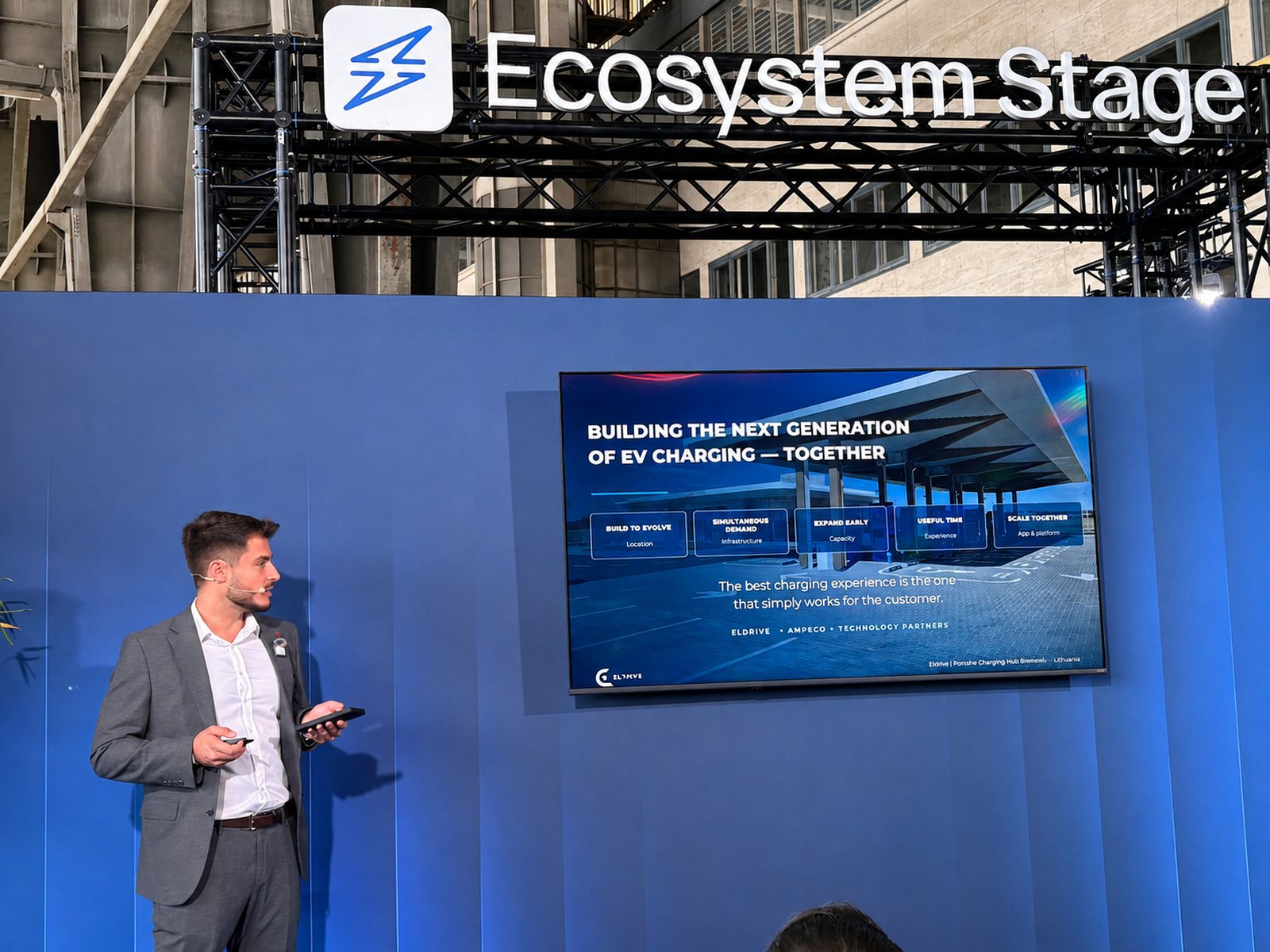
Pitești: why a 1 MW architecture
The technical centrepiece was SUPERNOVA Pitești in Romania, the first MOON – Alpitronic HYC1000 installation in Eastern Europe: a 1 MW shared power pool, four simultaneous outputs, up to 600 kW through a single CCS connector, and an MCS-ready architecture. It was not selected for the megawatt headline. The grid connection at that site could support a megawatt-class architecture, which is not true of most retail locations. The pool is built from sixteen 62.5 kW power modules, and any module can be assigned to any dispenser — so a vehicle that can accept 600 kW is not limited by a per-bay ceiling, and capacity is not stranded when four smaller cars arrive instead. The same cabinet can serve heavy-duty demand later without replacing the power electronics.
The site has grown with demand: 11 charging points when it opened in December 2025, 14 by May 2026. Monthly charging sessions there rose by around 40% once the new capacity went live, compared with the months before.
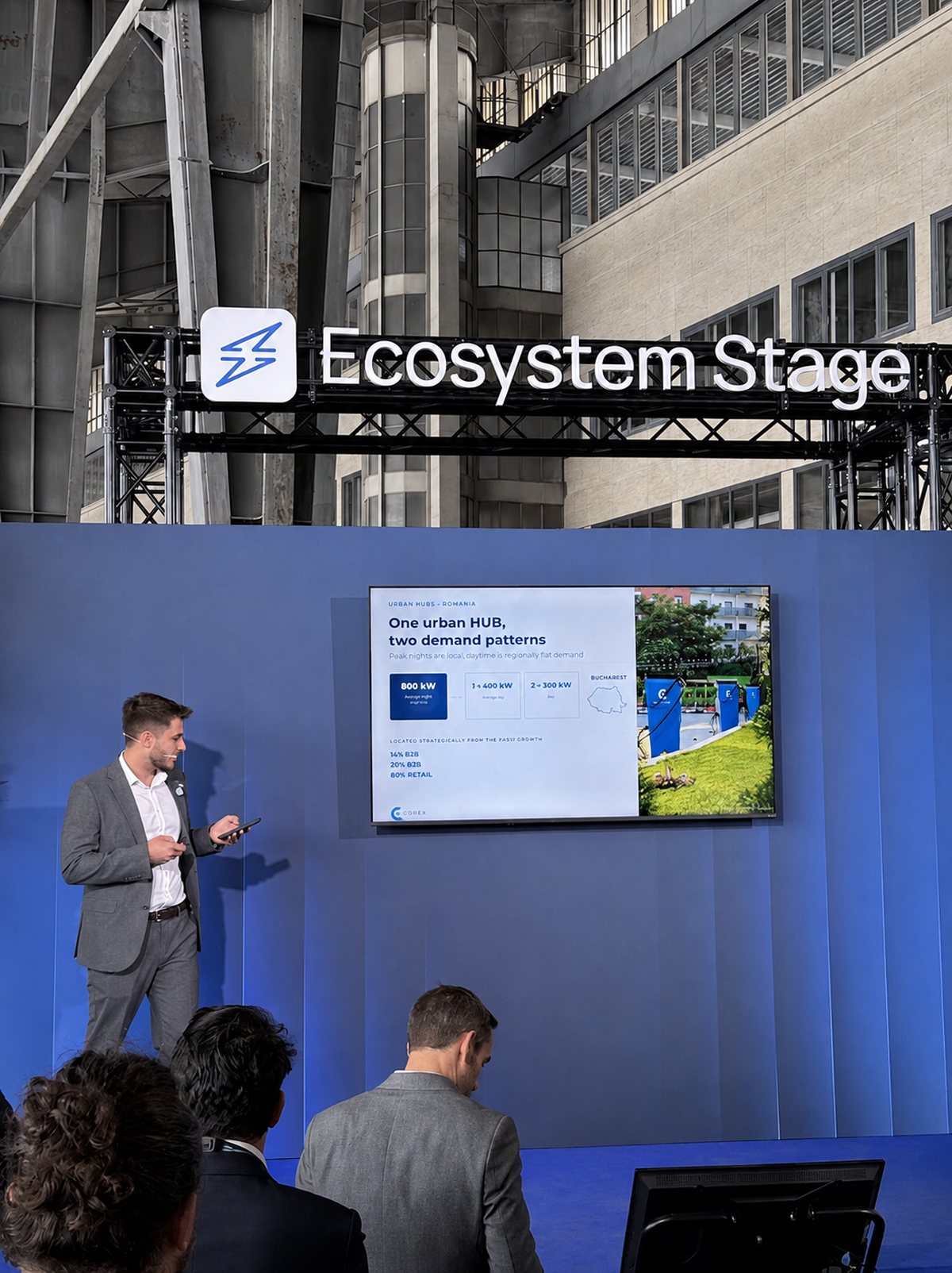
Bucharest: one urban hub, two demand patterns
Club One in Bucharest was the urban example: one site carrying two quite different demand patterns at once. Fleet vehicles charge to a schedule, and public charging happens around them. The two peak at different times of day, which changes how the available power is shared and how the bays are laid out. It is the same planning question as on a highway, with a different answer.
XO Park Sofia: one site, three demand profiles
In Bulgaria, XO Park Sofia showed a different architecture again — a 720 kW central power unit from Huawei Digital Power feeding six charging dispensers from a single shared dynamic pool. The dispensers are satellites with no power stage of their own; the power electronics sit in one cabinet, and power follows the vehicle rather than being permanently tied to a bay. What makes the site interesting is its demand mix: ordinary passenger cars, high-performance vehicles that can genuinely take high power, and electric trucks, all at one retail location. At the opening, the site hosted the first public Mercedes-Benz eActros charging demonstration in Bulgaria — a demonstration under peak-load conditions, not evidence of routine daily heavy-duty utilisation.
Power follows the vehicle — not a fixed output per charging bay.
High power is not limited to highways
The question Teodorescu expected from the room was whether any of this can be repeated. His answer was that Eldrive's differentiator is not one flagship hub, but the ability to deliver high power in very different settings. In Lithuania that means four highway hubs. In Romania it means Pitești's 1 MW system alongside ten 400 kW chargers at Fetești and three at Lehliu Gară, with the market plan doubling installed capacity from 42 MW to 84 MW during 2026. In Bulgaria it means more than 1,400 kW across 16 charging points on a single retail site at The Mall Sofia.
The technical capability behind the Eldrive name
Eldrive does not outsource the technical understanding of its network. Its own engineers assess grid connections and produce the electrical design, select the charger and system architecture, plan capacity and expansion, integrate multi-vendor equipment — Huawei, Alpitronic and XCharge hardware, all on the AMPECO platform, with roaming and B2B interfaces — commission and remotely operate the network, and handle field response, preventive maintenance, component replacement and site expansion.
The digital side: built around friction, not around technology
Eldrive's digital roadmap starts with observed friction rather than with a list of available technologies. Uncertainty before the journey — drivers want to know a charger will be free before they commit to a route — is answered with real-time availability and route planning. Too many steps at the charger is answered with Autocharge for compatible registered vehicles. Several vehicles on one account, for fleets and multi-car households, is answered with vehicle and charging-plan management in a single account. The same four tools exist in all three markets on one account, which is the practical reason for running a single platform across the group.
That platform is the AMPECO migration Teodorescu described as the digital backbone: more than 2,500 charging points, three markets, seven years of historical data and over 500 B2B partners moved live, with no customer-facing downtime. Customers, he noted, should experience the benefits of a migration and not the migration itself.
What comes next: storage as part of the network
A charging site is a large, spiky electrical load; adding battery storage behind the same grid connection turns that load into something schedulable. The near-term cases are peak shaving and power boosting — putting high power on a constrained connection instead of waiting years for grid reinforcement. Energy optimisation and grid-balancing services follow later, and depend on regulation and aggregation market by market. Teodorescu framed this explicitly as a direction: grid-balancing services are not yet operational across the Eldrive network.
Fireside chat: what actually limits growth
Immediately after the keynote, Dragoș Teodorescu joined Nikolay Dobrev, Market Director at AMPECO, on the Ecosystem Stage for a fireside chat covering how Eldrive chooses sites across Bulgaria, Romania and Lithuania, how a fast-growing network is kept reliable, and where the real constraints on growth sit.
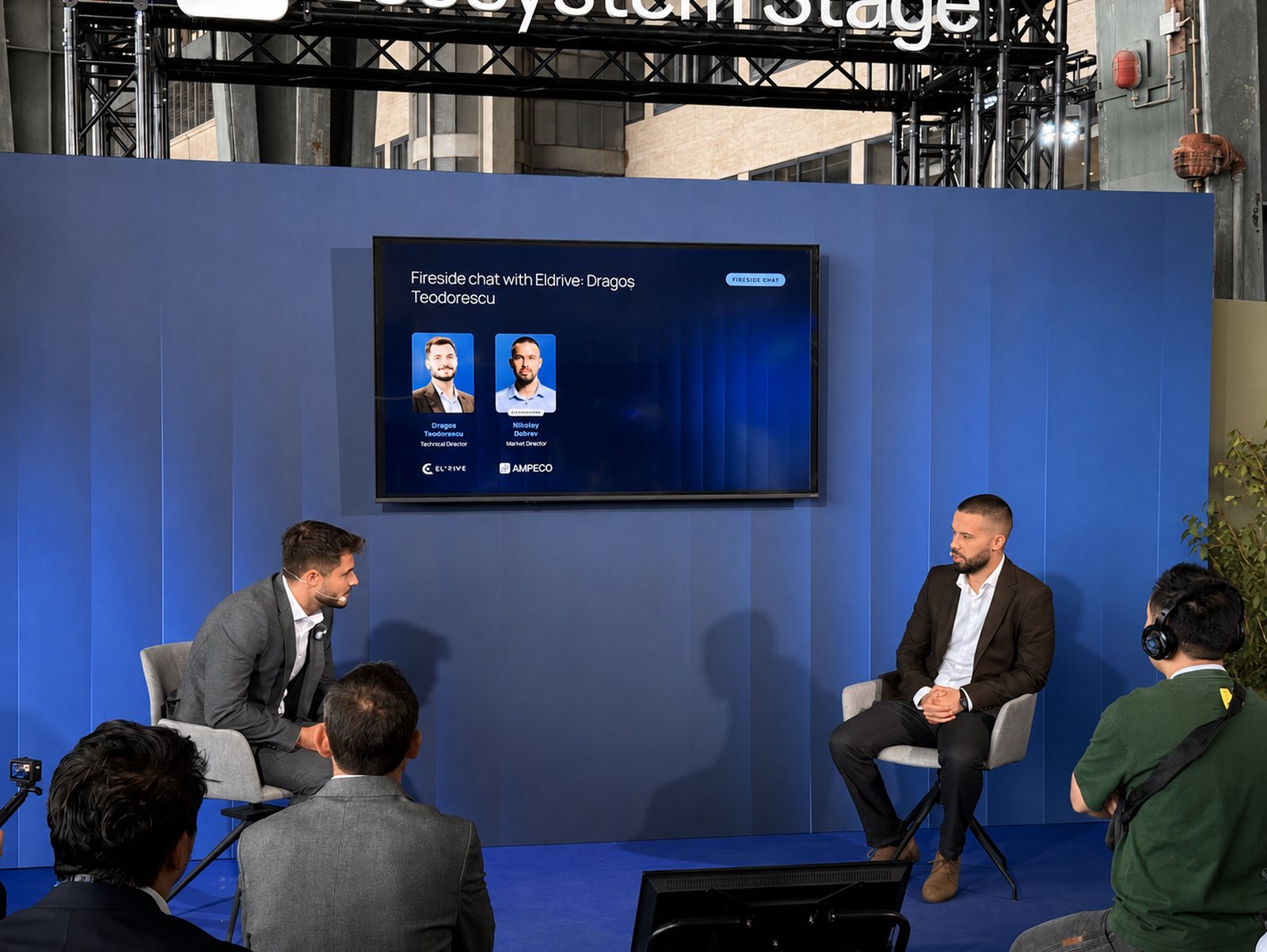
Dragoș Teodorescu
Technical Director, Eldrive Romania. He leads the rapid expansion of the company's charging network — grid assessment, electrical design, equipment selection and integration, and the operation of high-power sites across Romania. At icnc26 he presented Eldrive's approach to planning charging infrastructure from measured demand.
Building the next generation of EV charging — together
Eldrive operates high-power charging across Bulgaria, Romania and Lithuania, with its own engineers designing, integrating, operating and maintaining the network. If you are planning charging infrastructure for a site, a fleet or a portfolio, we are happy to talk about what the data says.


