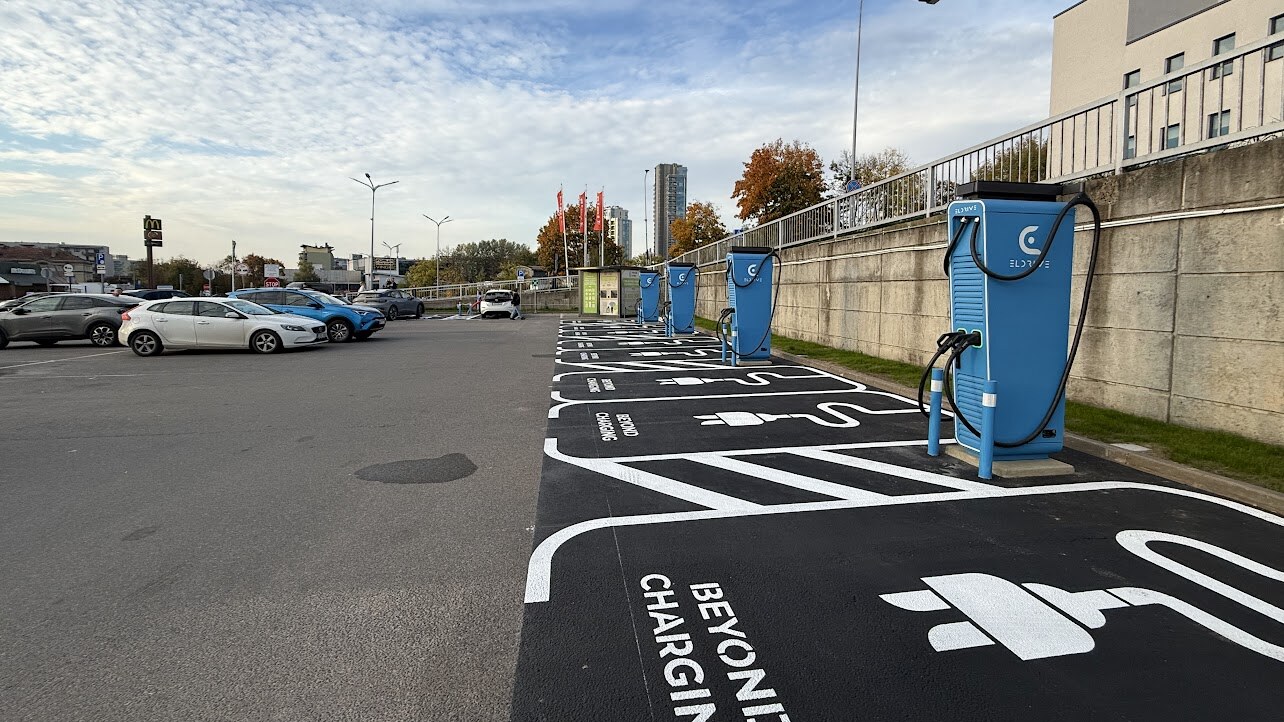
As the number of electric vehicles in Lithuania has grown by more than half in a year, the charging infrastructure is expanding too. Four new 200 kW Eldrive fast chargers are now operating at the Rimi Mylia shopping centre in Vilnius. The location now offers 800 kW of fast-charging power in total, and more than 20 electric vehicles can charge here at the same time.
Eldrive, which operates in Lithuania, Romania and Bulgaria, continues to expand its charging network in the capital. In the Rimi Mylia car park, next to T. Ševčenkos street, the company has installed four new fast-charging (DC) stations, each with an output of 200 kW.
They are complemented by 20 standard (AC) charging connectors of 22 kW each. This makes Rimi Mylia one of the largest and most powerful Eldrive charging locations in Vilnius.
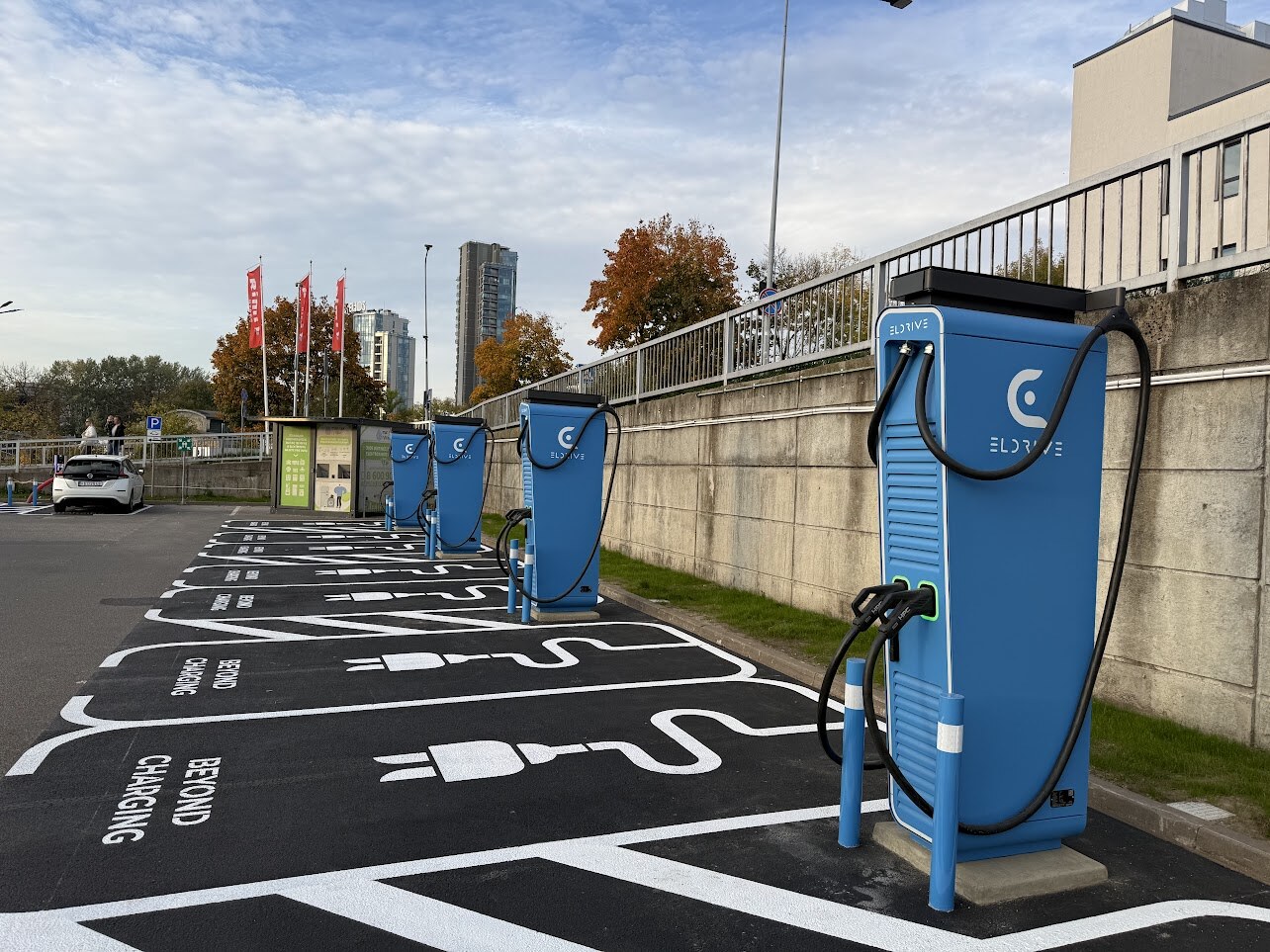
“We want charging an electric car in the city to be as easy as doing your shopping. At Rimi Mylia we have added a lot of power by installing four new fast chargers. Drivers can now choose at one location: charge quickly, or leave the car to charge for longer. Vilnius needs more and more charging locations like this,” says Tomas Tamašauskas, Head of Eldrive Lithuania.
Lithuania's EV fleet grew by more than half in a year
The charging infrastructure is expanding as the number of electric vehicles grows rapidly. According to the Lithuanian Electric Vehicle Association (ENA), 57,158 electric passenger cars were registered in Lithuania on 1 August 2026. Of these, 29,035 were battery electric vehicles (BEV) and 28,123 were plug-in hybrids (PHEV).
The fleet grew by 56.4% over the year. Electric cars now account for 3.03% of Lithuania's entire passenger car fleet, up from 2.02% a year earlier.
More recent data from the Ministry of Transport and Communications show that 31,074 battery electric cars were registered in the country on 1 September. A year earlier there were 20,817 – meaning the number of fully electric cars alone grew by about half in a year.
Electric cars are also gaining ground among new cars. According to ENA, electric cars accounted for 20.4% of all new passenger cars acquired in January–July 2026.
“Not long ago, an electric car seemed a fairly unusual choice to many people. Now everything is changing – their number in Lithuania has grown by more than half in a year. That is very rapid growth. The more electric cars there are on our streets, the more important it is that drivers can charge them conveniently. So we have to install chargers where people really need them, not just where they are easiest to build,” says Tamašauskas.
Charging where people already go
As the number of electric vehicles grows, so do the expectations placed on public charging infrastructure. Simply adding more chargers is not enough – it is just as important that they are convenient for drivers to use every day.
That is why shopping centres are a convenient place for chargers. People come here to shop or run everyday errands, so they can charge their car during the same visit, without planning a separate trip.
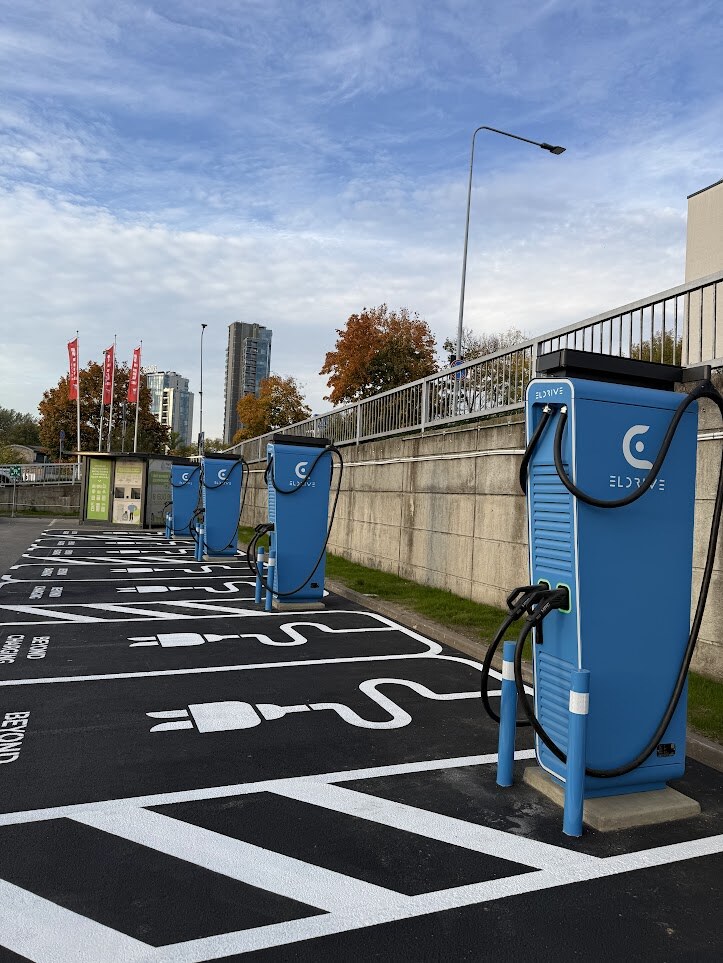
“I think we will increasingly rarely need to stop just to charge the car. You come to do your shopping, park the car, and it charges while you shop. What matters most to people is not the charger itself, but that charging is convenient and doesn't make them change their plans. That is why we are expanding our network at shopping centres and other places people visit every day,” says Tamašauskas.
At Rimi Mylia, drivers can choose between DC fast charging and standard AC charging. The location of the chargers and their real-time availability can be checked in the Eldrive mobile app, where users can also start charging and pay for it.
Benefits beyond drivers
The growth of electric mobility matters beyond the transport sector. As the number of electric cars grows, local air pollution from transport and dependence on fossil fuels decrease.
Electric cars can also be charged with electricity produced in Lithuania, including energy from renewable sources. The more of the energy needed for transport Lithuania produces itself, the less it depends on imported fuel.
“The growing number of electric cars is good news not only for their drivers. For cities it means cleaner air, and for Lithuania – less dependence on imported fuel. We can produce electricity ourselves, including from renewable sources. So the more people choose electric cars and the more options we have to charge them, the more the whole country benefits, not just drivers,” says Tamašauskas.
The Eldrive network keeps growing across Lithuania
Eldrive currently has around 190 EV charging locations in Lithuania, including four highway charging hubs. The network serves both drivers who travel around the city every day and those planning longer journeys.
The company operates in three markets – Lithuania, Romania and Bulgaria. The Eldrive network has more than 3,500 charging points in total.
About Eldrive
Eldrive is an electric vehicle charging network operator developing public charging infrastructure in Lithuania, Romania and Bulgaria. The company is part of Renalfa Solarpro Group: Renalfa IPP generates and stores renewable energy, Toki Power trades electricity, and Solarpro builds energy infrastructure.


