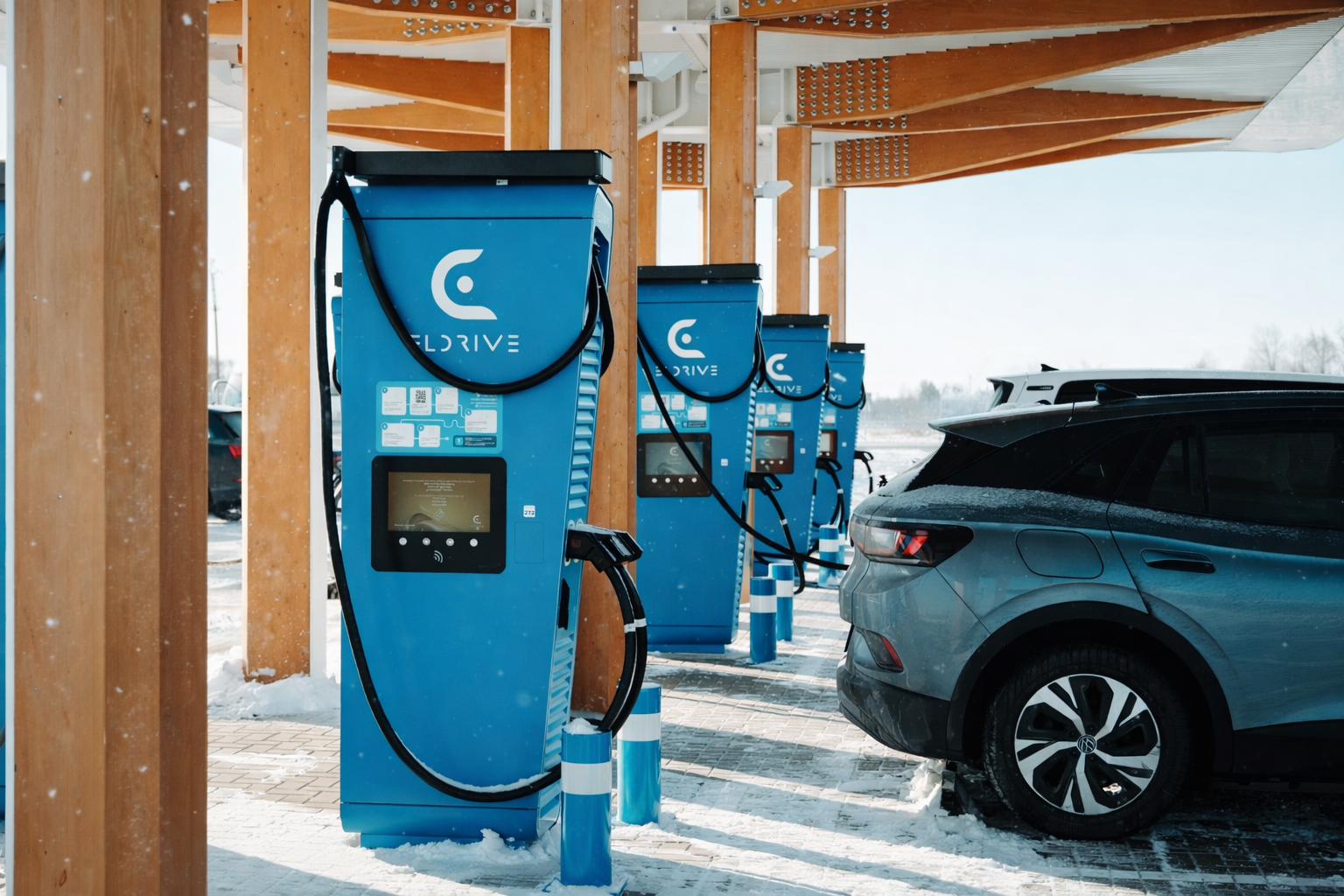
Despite frost of -30 °C, a quarter more electric vehicle charging sessions were recorded in Lithuania during the coldest week of winter than in December.
At the end of January and the beginning of February, Lithuania was hit by the coldest week of this winter – in some places the temperature dropped below -30 °C, which became a serious test for drivers. Nevertheless, the data show that even in extreme weather conditions, Lithuanians continued to travel successfully, and electric cars remained a reliable vehicle for everyday and intercity journeys.
Charging sessions increased by a quarter
According to Eldrive Lithuania data, EV charging intensity during the coldest week was significantly higher than during the festive weeks of December – the number of charging sessions increased by about a quarter, and the amount of electricity consumed rose by about a third. These changes were driven by the fact that the biting cold naturally reduced the range of electric cars. “In such cold, the range of electric cars naturally decreases – usually by about 30–40 percent, so drivers tend to charge more often and for longer in winter,” says Tomas Tamašauskas, Head of Eldrive Lithuania. According to him, it is also important that if the battery is preconditioned, the charging speed does not drop as drastically, so electric cars remain reliable for both everyday trips and longer routes, even in winter.
A jump in Vilnius and Kaunas, stable in Klaipėda
In the largest cities – Vilnius and Kaunas – EV charging activity increased significantly during the coldest week. This is linked not only to residents' daily commutes to work, but also to the fact that business-sector electric vehicles continued to be operated as usual. Meanwhile, in Klaipėda, the number of charging sessions remained stable – even the harsh weather did not significantly change the habits of residents and visitors to the city.
A quarter more charging sessions at Rimi car parks, no drop in travel on highways
EV charging stations at Rimi shopping centres remained in particularly high demand during the coldest week. Compared with December, the number of charging sessions at them was more than a quarter higher.
According to data from the Eldrive Porsche charging hubs, the fast-charging stations installed on the highways did not lack customers during the coldest week. Compared with December, almost the same number of charging sessions was recorded, so intercity travel continued as usual. Even at extremely low temperatures, drivers did not give up their trips – for example, the number of people heading to the seaside did not decrease, so the charging infrastructure on the Vilnius–Klaipėda highway remained an important part of travel.
The coldest days revealed increased activity among electric car drivers who usually rarely use the public charging network. Some of them usually charge their electric cars at home or use public stations only in the warmer months (especially when travelling). However, the severe cold prompted these drivers to opt for public charging more often. This shows that in winter, public charging infrastructure becomes important even for those who usually manage without it.
Growing confidence in electric cars
The coldest week of winter proved once again that electric cars in Lithuania are regarded as a reliable vehicle even in the cold season. Drivers used them not only for everyday trips in cities but also for intercity travel, and use of the public charging network remained stable and even grew. This signals growing confidence in electric cars – people do not give them up even in severe frost and treat them as a fully fledged vehicle in all seasons.


