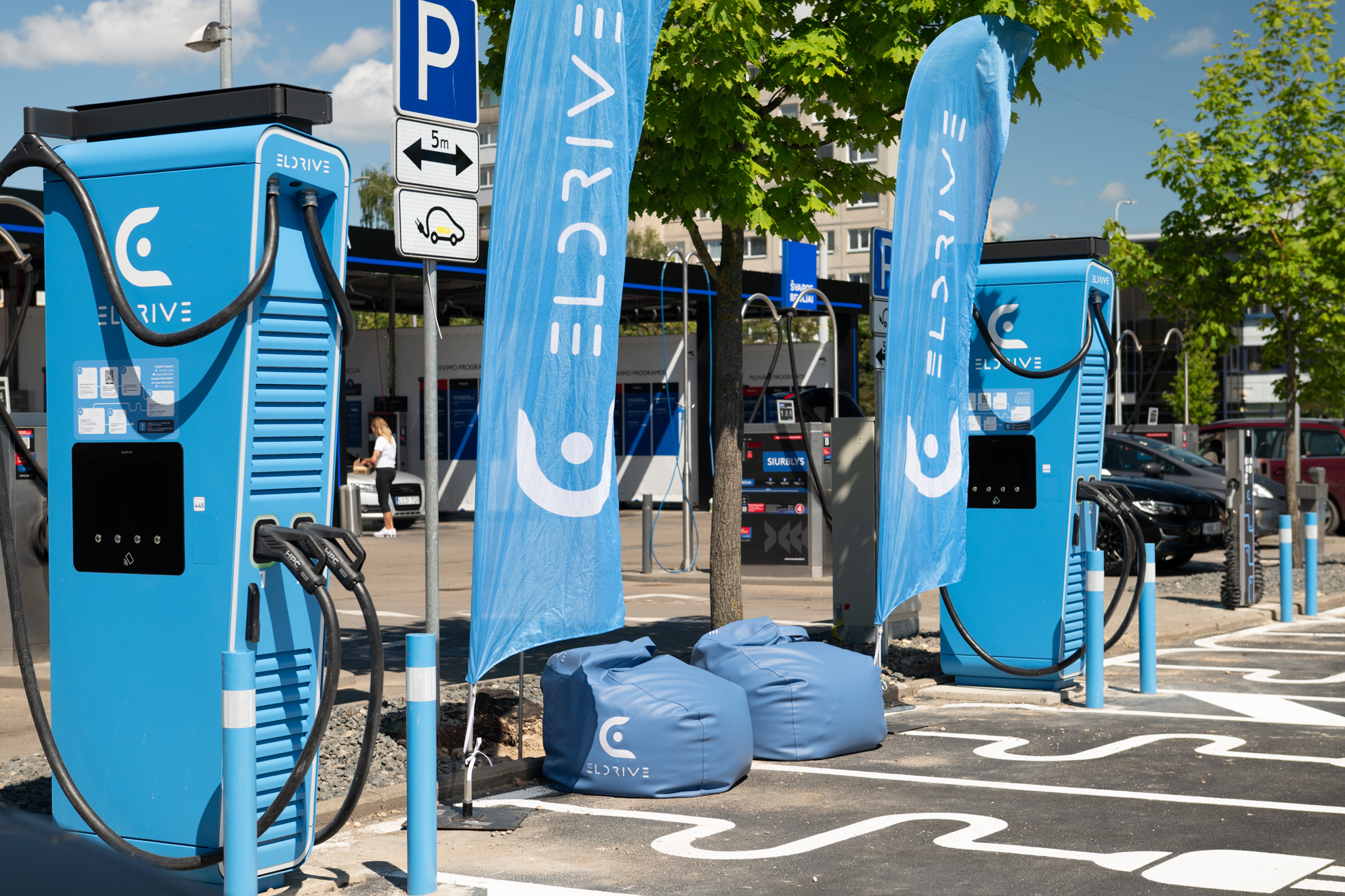
The Midsummer (Joninės) week that has just passed in Lithuania confirmed once again that Lithuanians are travelling more and more by electric car. According to data from the EV charging infrastructure network Eldrive, the number of charging sessions grew throughout the week, with the highest activity recorded on Sunday, 28 June, when most residents returned home after the long weekend.
According to Tomas Tamašauskas, Head of Eldrive Lithuania, record traffic was recorded on the country’s main roads, especially on the A1 highway.
“On 28 June, we recorded the highest number of charging sessions in Lithuania in Eldrive’s entire history. Compared with Christmas or other holiday periods, there were about 42% more charging sessions at our charging hubs on the A1 highway. However, what pleases us most is not the record itself but the fact that even with such traffic, drivers were able to charge conveniently. This is exactly why we are investing in larger charging hubs on Lithuania’s main roads,” says T. Tamašauskas.
As the number of trips grows, Lithuania’s EV fleet is also expanding rapidly. According to the latest data from AB Regitra, on 1 June 2026, 53,599 M1 and N1 category electric vehicles were registered in the country – 28,014 battery electric vehicles and 25,585 plug-in hybrids.
According to T. Tamašauskas, this is also reflected in people’s travel habits.
“A few years ago, longer journeys by electric car still raised questions for many. Today we see a completely different picture – people drive electric cars to the seaside, to Dzūkija or other regions of Lithuania just as naturally as they would a car with an internal combustion engine. I think this shows best that infrastructure and drivers’ confidence in electric cars have already reached a completely different level.”
Traditionally, the heaviest traffic was recorded in the direction of the seaside, but significant growth was also seen in other regions of Lithuania.
At the Panevėžys charging hub, the number of charging sessions grew by about 34%, and double-digit growth was also recorded in the Utena region.
“This shows that on holiday weekends, EV drivers travel not only to the seaside. More and more people are choosing various destinations across Lithuania, and as the number of electric cars grows, this distribution is becoming ever more pronounced,” says T. Tamašauskas.
Dzūkija also remained one of the most popular destinations. However, the Eldrive charging hub in Senoji Varėna is actively used all year round, so growth there over the Midsummer weekend was more moderate – about 11% compared with a normal weekend.
During the holiday period, changes were seen not only on the highways but also in the major cities.
According to Eldrive data, the number of charging sessions at charging locations in Vilnius and Kaunas, especially at large shopping centres, fell by about 15%.
“This is a very natural phenomenon. When a large proportion of people spend the weekend at the seaside, in resorts or in other regions of Lithuania, charging traffic moves along with them. We see such changes over practically every long holiday weekend, and in the first days of the working week everything returns to its usual rhythm,” says T. Tamašauskas.
Although drivers spent slightly more time at the charging hubs during the holiday period, the average amount of energy per charging session did not change significantly.
According to T. Tamašauskas, the growing average charging speed is much more noticeable.
“We see that EV drivers are becoming increasingly experienced. They plan their journeys better, know how to prepare the battery for fast charging, and newer electric car models make it possible to reach higher charging speeds. As a result, even as traffic grows, our charging hubs can serve more customers, and the average stop still usually lasts around 25–35 minutes.”


