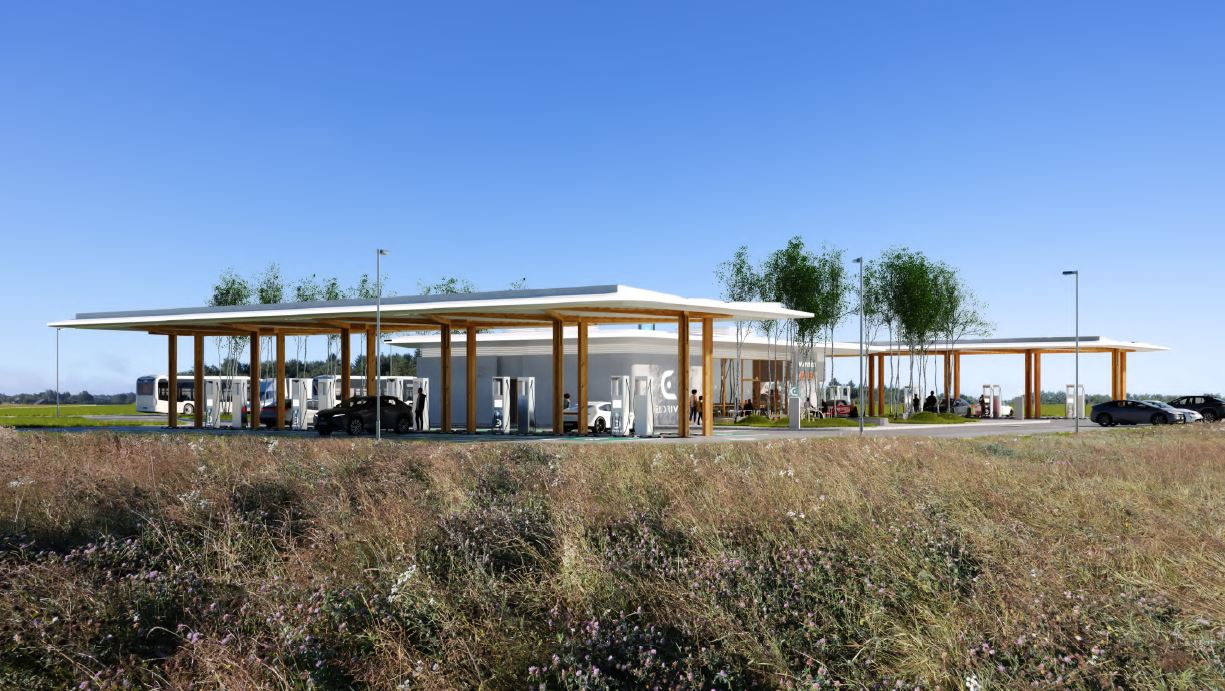
Electric vehicle charging infrastructure developer Eldrive announces that on 11 December the first charging hub of its kind for electric vehicles, not only in Lithuania but in the Baltic states as a whole, will open its doors. At the hub opening on the Panevėžys bypass, as many as 20 electric vehicles will be able to charge at the same time. It will house a Caffeine café, a Narvesen shop, rest and work areas, a children's playground and a childcare room.
We talk more about the project with Tomas Tamašauskas, Head of Eldrive Lithuania.
Tomas, on 11 December you are opening Lithuania's first electric vehicle charging hub near Panevėžys. Tell us more about this project.
Yes, on 11 December the first electric vehicle charging hub in our country will officially open its doors. It is a long-awaited moment that we started working towards back in 2022. Our team and partners put a great deal of effort into creating a modern and innovative charging hub concept.
This hub not only marks a new stage in the development of electric vehicle infrastructure in Lithuania, but also makes a significant contribution to promoting e-mobility in our country. Given that the number of electric vehicles in Lithuania grew by more than 70% in 2023, projects like this are essential if we are to meet growing demand and encourage a sustainable future for transport.
Why did you choose the Panevėžys district for the first hub?
The Panevėžys district is a strategically important location because it lies on the Via Baltica road, which connects the Baltic states and is vital for international transport. This road is one of the main north–south transport arteries, with around 15,000 vehicles passing along it every day, which makes it an ideal location for our hub.
In addition, it is halfway between Vilnius and Riga, which makes it even more important. By choosing this location, we aim to ensure that both local and intercity drivers can conveniently charge their electric vehicles and continue their journey without worry. This will not only make travelling more comfortable, but will also help encourage the use of electric vehicles in Lithuania.
What will make this charging hub stand out?
This hub is unique because of its size and its technological solutions. In the first phase of the project, up to 20 electric vehicles will be able to charge here at the same time, and in the future we plan to expand the hub so that as many as 40 vehicles can charge simultaneously. It will be one of the largest hubs of its kind in the Baltic states, able to serve a high flow of electric vehicles.
The hub will be equipped with charging stations from Alpitronic, one of the most reliable European manufacturers, each with a charging power of up to 200 kW and the option to increase the power to 400 kW in the future. This will allow drivers to charge their vehicles quickly – some electric vehicles will be able to charge to 80% in just 10–15 minutes. Visitors will certainly notice that the charging hub has a modern design with innovative solutions. The building has spacious rest areas, a Caffeine café, a Narvesen shop, a children's playground and a childcare room. We want every visitor to find what they need to spend their time comfortably and pleasantly.
You mentioned that you started implementing this project in 2022. What were the biggest challenges during this period?
There were many challenges, and we face them every day, because this is a project unlike anything Lithuania has seen before.
The biggest challenge was creating the whole concept. From the outset we set ourselves a few main goals – a large number of electric vehicle charging spaces, so that drivers could charge their vehicles quickly and without extra queues and continue their journey. Another important goal was a commercial building, so that people who stop could go to the toilet, buy food and drinks, or simply sit and wait while their vehicle charges. Overall, the main challenges related to choosing suitable locations, using the plot efficiently, adapting the infrastructure and securing a high-power electricity supply.
In addition, we had to align the interests of many partners and make sure that the hub meets the needs of both current and future electric vehicle drivers. I am glad that after intensive work we can now see real results.
Are you planning to open more hubs like this in Lithuania?
Yes, we have already started construction on the A1 highway between Vilnius and Klaipėda and in Senoji Varėna, near the junction of the Vilnius and Alytus roads. These projects are part of our strategic plan to create a wide network of charging hubs across the country.
Each hub is unique and adapted to the needs of its specific location. For example, the hub in Senoji Varėna will be more compact, with up to 10 electric vehicles able to charge at the same time, but it will also have all the rest areas and a Caffeine café with a drive-in option, meaning drivers will be able to buy coffee or snacks without getting out of their vehicle. Our goal is to create a national network of charging hubs that will allow electric vehicle drivers to travel without limits throughout the country.
How do your charging hubs differ from traditional charging locations?
Our hubs are designed as stand-alone destinations in their own right, not just charging spots next to existing facilities. They stand out for their large number of charging stations and high power, their modern design and comfortable rest and work spaces. We understand that it is important for people to have a place where they can spend their waiting time well – have a coffee, eat or even do some work.
The hub is designed for a wide audience: not only individual drivers, but also families with children. We have installed special parent-and-child rooms and children's playgrounds. Of course, everyone will be able to stop here, not only those who drive electric vehicles.
In addition, we pay a lot of attention to safety and comfort. The hub will operate around the clock, is well lit and monitored by video cameras, so drivers can feel safe at any time of day or night. This is particularly important because many traditional charging locations often lack proper lighting or comfortable waiting areas, which can cause inconvenience and a sense of insecurity. Our goal is not only to provide a standard charging service, but also to create a pleasant environment that meets the needs of today's consumers.
What impact do you think these charging hubs will have on the growth of electric vehicles in Lithuania?
I am convinced they will have a major impact. One of the main reasons why people are not yet choosing electric vehicles is the lack of infrastructure, especially in Lithuania's regions. According to research, around 60% of potential electric vehicle buyers are worried about charging options while travelling.
By creating convenient and reliable charging infrastructure on the country's main roads, we are making it much easier to charge vehicles not only in Lithuania's major cities, but also where charging stations are most lacking. This will encourage more people to switch to electric vehicles, which in turn will contribute to protecting the environment and developing sustainable transport. We expect that within the next five years the share of electric vehicles on Lithuania's roads will grow to 10% of all vehicles.
What are your future plans once these hubs are open?
We plan to keep expanding the network of charging hubs of this type and to install stand-alone charging stations throughout Lithuania. We will also seek to improve our services, taking into account customer feedback and market trends. Our vision is for e-mobility infrastructure to be not only functional but also attractive, encouraging a sustainable lifestyle and meeting the highest quality standards.


