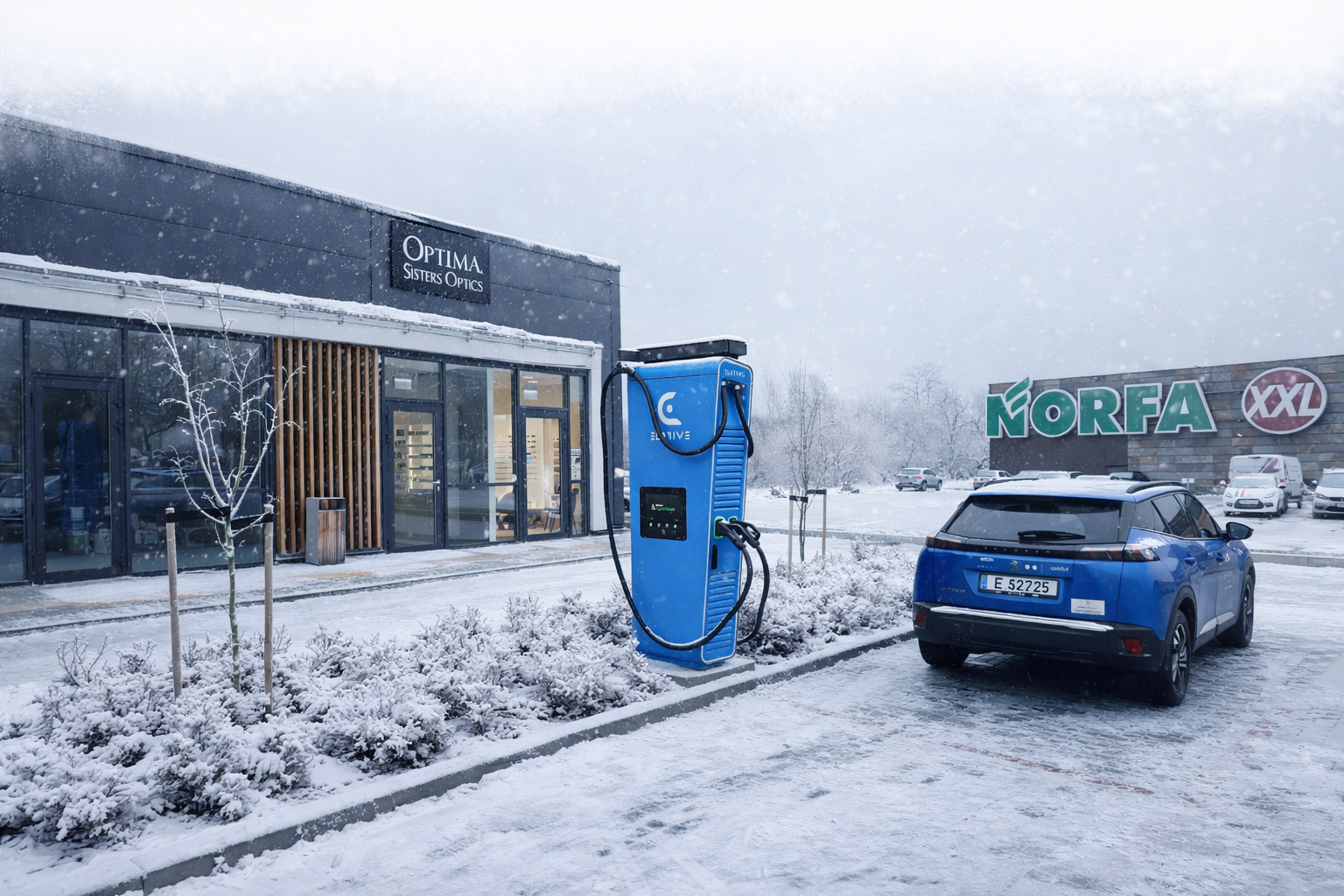
As winter frosts approach in Lithuania, with forecasters predicting temperatures down to –10 °C during the day and even –20 °C at night, some drivers naturally wonder whether such weather conditions will affect electric vehicle charging. EV infrastructure specialists offer reassurance: the charging stations themselves operate reliably and without interruption in winter, and the main focus should be not on them but on the condition of the car's battery.
According to Tomas Tamašauskas, Head of Eldrive Lithuania, low air temperatures have no significant impact on charging infrastructure. All charging stations operated in the Eldrive network are technically adapted to work in Northern European climate conditions and ensure stable operation even in very severe cold.
“The cold does not cause any problems for charging stations – they operate successfully even at –30 °C. All our infrastructure is designed so that drivers can feel at ease regardless of the weather,” says T. Tamašauskas.
However, charging speed may differ from usual in winter. This is determined not by the stations but by the electric vehicle itself – more precisely, by its battery temperature and state of charge. A cold battery physically cannot accept maximum power, so charging may be slower than in the warmer months.
“Charging speed is most affected by battery temperature and remaining capacity. If an electric vehicle has been parked outside for a long time, the battery cools down and the system automatically limits the charging power to protect it. Slower charging in such cases is a natural process and has nothing to do with how well the station is working,” explains the Head of Eldrive Lithuania.
Data from manufacturers and operators show that charging speed can drop by around 10–30% in winter, depending on the specific EV model, the battery chemistry and whether the battery preconditioning function is used. Most newer electric vehicles automatically warm up the battery while driving to a fast-charging station if it is set as the destination in the car's built-in navigation.
“It is worth knowing that battery preconditioning is often activated only when the charging station is selected in the car's navigation system. When using external apps such as Google Maps or Waze connected via CarPlay or Android Auto, this function may not switch on. Some newer models allow battery preconditioning to be activated at the press of a button, but there are also cars that have no such function at all. In such cases, higher charging speeds can be achieved by arriving with a lower battery level – around 10% – and allowing more time for the charging itself, which naturally warms up the battery,” emphasises T. Tamašauskas.
The operator's data also show that the number of EV charging sessions in Lithuania does not fall in the winter months – on the contrary, it often rises slightly. At the same time, no technical faults related to low temperatures are recorded. This confirms that the country's EV charging infrastructure is sufficiently mature, reliable and adapted to real climate conditions.
In summary, experts agree that low temperatures are not an obstacle to charging an electric vehicle. Although charging may take longer in winter, inconvenience can be avoided by planning your route properly, using battery preconditioning functions and taking the car's technical capabilities into account. Charging stations do their job reliably – even in the harshest cold.


